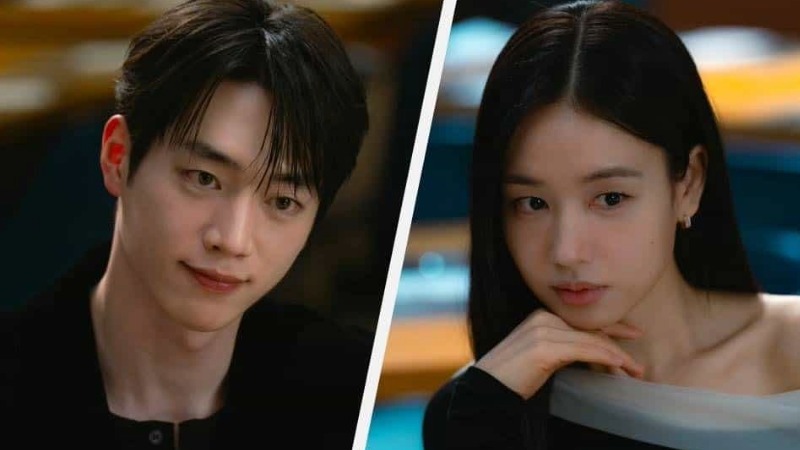
For the first stretch of A Love Other Than Yours (너 말고 다른 연애), I thought I was watching the most grown-up romance KBS had aired in years. By the finale, I was watching two talented leads circle a script that had forgotten what it wanted to say. This is a drama with a genuinely interesting question at its heart, strong actors, and an opening that earns real goodwill, and then it trades that question for melodrama. It is worth sampling, but it is hard to recommend all the way to the end.
What Is It About?
The setup is refreshingly unglamorous. Nam-goong Ho (Seo Kang-joon) and Lee Mi-do (Ahn Eun-jin) have been together for more than ten years. There was no betrayal and no villain, just the slow fade that comes with time: routine, exhaustion, and the quiet fear of becoming a burden to each other. Both are worn down by their lives and their jobs, and the spark that once defined them has gone dim.
Then new people enter the picture. Tae-seung (Lee Joo-ahn), a sharp-edged lawyer, takes an interest in Mi-do. Soo-ah (Jo A-ram), a junior colleague, is drawn to Nam-goong. The drama asks what happens when a long relationship stops feeling like a choice and starts feeling like an obligation, and whether feelings for someone else are a betrayal or a symptom of something that was already fading.
It is written by Yoo Su-ji and directed by Hwang Seung-ki and Lee Ga-ram, and it airs in the weekend slot on KBS2 with 75-minute episodes.
The Good: A Premise Worth Taking Seriously
Korean romance is full of first meetings, love triangles, and chaebol heirs. Very few dramas want to talk about the middle of a relationship, the long, unspectacular years where love has to be maintained rather than discovered. That is a mature subject, and the early episodes treat it with care.
The opening hours are where the show is at its best. The distance between Nam-goong and Mi-do is built from small things: conversations that stop halfway, tenderness that has turned into habit, two people who are protecting each other so carefully that they have stopped being honest. The point that falling for someone else does not make a past love fake, only buried under pain and insecurity, is a smart one, and the early episodes capture it well.
Mi-do is the strongest piece of the writing at the start. She is introduced as a woman ground down by circumstance. Due to an unfair lawsuit, she ends up directing an adult film purely out of necessity, which is an unusual and morally textured place to begin a heroine. She is tired, prickly, and funny in a worn-out way, and Ahn Eun-jin plays her with a bone-deep weariness that feels lived in rather than performed.
The Cast
Seo Kang-joon (Nam-goong Ho) has the harder assignment. Nam-goong is a quiet, withholding character, and Seo plays him with restraint, letting guilt and fatigue show in the pauses. Unfortunately, as the plot grows more contrived, the character is reduced to looking hollow. That is a writing problem, not an acting one.
Ahn Eun-jin (Lee Mi-do) is the reason the early episodes work. Her chemistry with Seo has a lived-in quality, the kind that makes a decade together believable without a single flashback doing the heavy lifting. Even when the script lets her down, she finds flickers of the character she began as.
Lee Joo-ahn (Tae-seung) plays a pursuer who is immature and abrasive, and the drama never fully decides whether we are meant to find him charming or irritating. Jo A-ram (Soo-ah) does what she can with a role that, sadly, has very little to hold on to.
The Turn: Episode 8 and the One-Month Experiment
The hinge of the story comes around Episode 8, when Nam-goong and Mi-do agree to see other people for a month. On paper, it is a bold move: the show is finally going to test whether their love can survive an honest look at the alternative.
In practice, this is where the drama starts to come apart. Instead of deepening the two leads, the script begins to flatten them. Mi-do’s own problems, her troubles at work, her exhaustion, her sense of being stuck, are quietly dropped. She becomes either tearful or deadpan, defined almost entirely by her guilt over hurting Nam-goong. The character who began as feisty and fiery turns into a weeping centrepiece torn between two men.
Nam-goong fares little better. He spends the month dating Soo-ah while looking, to put it kindly, emotionally absent.
The Women Problem
This is where I part ways most strongly with the drama, and I am not alone: critics have called the series cruel to its women, and I understand why.
Soo-ah is the clearest example. She keeps declaring her love for Nam-goong, fully aware of his ten years of history, and promises to keep loving him even if he goes back to Mi-do because she only wants what is best for him. The show wants this to read as selflessness. What it actually reads as is a character with no desires, no personality, and no life outside of a man who is not that interested in her. She is a plot device with a pulse.
Mi-do is punished in a different way. She is the one who caught feelings for someone else, and the narrative seems determined to make her pay for it, turning her into a vessel for guilt rather than a person making a hard choice. For a drama that began with such a distinctive female lead, this is a real waste.
The Guilt Twist That Backfires
The most contrived element is the backstory binding the two leads together. Nam-goong blames himself for the death of Mi-do’s father, who saved him from drowning when he was seven. Mi-do, suddenly, blames herself too, since she was the one who told her father to go and help.
The drama half-acknowledges how forced this is: Nam-goong himself points out that she cannot insult her father’s memory this way. But the damage is already done. A tragedy this neat rewrites the entire relationship in retrospect. Once there is a debt on the table, ten years of love start to look like ten years of penance.
That is the heart of the problem. The show begins by asking a relatable question: what happens when love gets tired? It ends by asking a melodramatic one: can you love someone you owe? It never commits to answering either.
The Ending
The finale is where goodwill runs out. Nam-goong announces he will disappear from Mi-do’s life, and she sobs violently, but the drama offers very little resolution for her. In a last-minute gesture, she is handed a new career path, as though the writers suddenly remembered she once had one outside of the romance.
It is an ending that feels both abrupt and unearned. A story about two people outgrowing each other needs those people to grow, and here nobody really does. By the end, the characters have eroded rather than evolved, and the grimness has replaced depth.
Direction, Tone, and Pacing
The show leans hard into a muted, realistic tone, in line with the current wave of sober Korean romances. The problem is that realism and misery are not the same thing. Realism needs specificity: jobs, money, friction, small humiliations. Misery only needs sad faces. Somewhere past the midpoint, the drama swaps the first for the second, and the result is a long, joyless stretch in which everyone looks heartbroken and nobody quite knows why.
The pacing, at 14 episodes of 75 minutes, also works against it. A tighter story would have hit its emotional beats harder; stretched out, the repetitive cycle of guilt, tears, and silence starts to wear.
How Did Audiences React?
The numbers tell a mixed story. The premiere drew a modest 2.6% in Nielsen Korea ratings, landing at the bottom of the terrestrial pack in a crowded slot. Yet viewers who finished it have been kinder than critics: it currently holds a 7.9 out of 10 on MyDramaList from several hundred users. That gap suggests the show has an audience that connects with its slow-burn sadness, even as reviewers point to its structural flaws.
Who Should Watch It?
- Watch it if you love quiet, character-driven relationship dramas, you are a fan of Seo Kang-joon or Ahn Eun-jin, or you want a story about long-term love that avoids fairy-tale gloss.
- Skip it if you need a satisfying, well-resolved ending, you are sensitive to stories where female characters are sidelined or punished, or you prefer your realism with a little warmth.
- Best approach: watch the first six or seven episodes, where the writing is strongest, and decide for yourself whether to follow it past the one-month experiment.
Final Verdict
A Love Other Than Yours is a drama I wanted to love. Its central idea is rare and worth telling, and for a few episodes it tells it beautifully. Seo Kang-joon and Ahn Eun-jin are good enough to make you believe in ten years of shared history from a single look. But the script loses its nerve, burying a thoughtful question under contrived guilt and leaving its women with far less to do than they deserve.
It is a story about two people who stop growing, and, frustratingly, the writing stops growing with them.
Have you watched it? Did the ending work for you, or did it leave you staring into the middle distance? Tell me in the comments.
