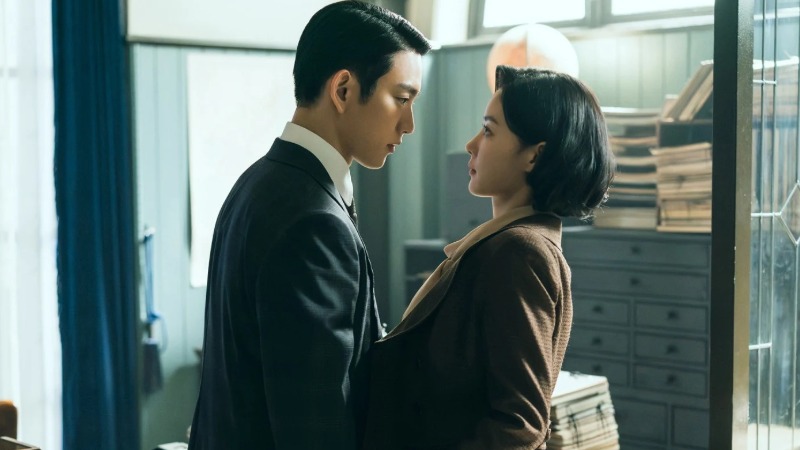
Lee Ga-kyung (Kim You-jung) is the best pickpocket in Gyeongseong, and she has one goal: save enough money to leave for the United States. Instead, she is recruited by the independence movement for a 100-day mission. She is to go undercover as an interpreter inside the Japanese Government-General, gathering secrets and supporting an assassination plot.
Inside she meets Kim Tae-woong, who goes by Sato Hideo (Park Jin-young). He is an elite interpreter and the adopted son of a powerful official, a man who has spent his life working within the very system she is there to undermine. The tagline says it all: it was a lie that lasted 100 days.
The drama is tvN’s flagship project for its 20th anniversary, and it was marketed on a promise of three things at once: high-stakes espionage, a heartbreaking love story, and the sacrifices of the freedom fighters who gave everything for independence.
The first impression: a pickpocket in the wrong crowd
The opening episodes drop Ga-kyung off a train from Manchuria and straight into trouble. Reviewers noted that her talent for lifting wallets keeps backfiring, because she keeps stealing from people dangerous enough to end her life. That is a smart engine for a thriller. Her skill is real, but it doesn’t make her safe; she is plainly in over her head, and so are we.
The pilot did its job. One recapper described it as immediately engaging and bristling with tension despite some clunky exposition, and by Episode 2, with the assassination plot at the Yoo household unfolding, that same critic called it harrowing and brilliant. Another reviewer singled out the tension of that household sequence as impressive. Viewers agreed: the drama passed 7 percent in viewership after two episodes, a strong start for a cable weekend slot.
Kim You-jung carries the lie
The role asks Kim You-jung to play someone who is lying to everyone, including at times herself, and the drama lives or dies on whether we believe Ga-kyung is a survivor first and a patriot second. That is a more interesting position than the usual noble resistance heroine, and it gives her room to be funny, frightened and morally murky within a single scene.
The structure helps. Ga-kyung doesn’t begin as a believer. She accepts the mission from Yoo So-ran (Kim Hyun-joo), and the early episodes keep returning to the gap between what she needs and what the cause demands. A turning point is promised and delivered over the first half, and the best material comes when her ability with languages, which makes her useful as an interpreter, is turned against people she might otherwise sympathize with. One recap of Episode 6 describes her facility with languages making her sadly indispensable when it comes to getting suspected revolutionaries to talk. That is a genuinely uncomfortable position for a spy, and the drama knows it.
Park Jin-young and the problem of Sato Hideo
Sato Hideo is the more difficult role. He is Korean by birth, Japanese by upbringing and position, and he is the one person who recognizes Ga-kyung from her first night back in the city. That recognition sets up the central cat-and-mouse dynamic: he suspects her early, and the suspicion only grows.
Park Jin-young plays him with a controlled stillness. Promotional material emphasized the way he changes after meeting Ga-kyung, and the performance is at its best when you can’t tell whether a kind gesture is affection or interrogation. That ambiguity is the heart of the romance.
The romance versus the spy plot
Here is where the critical conversation gets split. One reviewer argued by Episode 8 that the show works better as a period spy thriller than as a romance. I think that’s fair, and it’s not entirely a complaint. The romance is built on suspicion, surveillance and withheld information, so it can never relax into the swoony register many viewers expect from a K-drama love line. Moments like Hideo catching Ga-kyung before a fall land because the stakes around them are so high, but the pairing is at its most compelling when it is also a threat.
If you come for a pure slow-burn romance, you may find the tension more stressful than sweet. If you came for the spying, the love story is the emotional pressure that makes each risk matter.
The supporting cast and the Gugukdan
The independence group, the Gugukdan, gives the drama its moral weight. Kim Hyun-joo’s Yoo So-ran leads with a hard-edged calm, and she is paired with Lee Moo-saeng’s Yoo Philip, a Korean-American correspondent. The two operate as a fake married couple, a classic espionage device that gives both actors room for dry chemistry. Jin Sun-kyu plays Sato Shinichi, the official at the center of the early assassination plot, and the opposing machinery of the Government-General is a credibly menacing presence.
Episode 4’s sequence, in which Ga-kyung is captured and held at Jongno Police Station while maintaining a false identity as an interpreter, is a good example of how the drama uses the supporting cast. The danger is not abstract; people we’ve come to know are hit, and the resistance is repeatedly shown to be outgunned.
Direction, production and tone
Yoo In-sik is best known for warm, character-driven work, so the move to a colonial-era thriller is a notable shift. The scale is handsome, and Gyeongseong Station is used as both a visual anchor and a thematic one. The director’s own pitch was an invitation to step onto the platform and join an exhilarating journey, and the early pacing honors it.
The weaknesses are real, though. One review felt that while the danger is constant, the world itself doesn’t always feel lived in. Another critic admitted that Episode 6’s subplot about a pneumatic tube system was hard to follow. And early on, a recapper confessed to not fully understanding every character’s motives, which is a fair mark against a plot that depends on shifting loyalties.
Does it earn the Mr. Sunshine comparison?
The Korea Times review framed expectations in terms of Mr. Sunshine, the landmark colonial-era romance, asking whether this drama could reach similar legendary status. It is too early to say, and honestly, a comparison that heavy sets the bar very high. What the drama does share is the sense that personal feeling and national history are inseparable. What it doesn’t yet share is the poetic sweep of that earlier classic. This is a tighter, more plot-driven machine.
Ratings and reception
The numbers have moved in the right direction. After a 7 percent-plus opening weekend, the drama reached its highest ratings yet on October 25, and critics covering the series have generally rated individual episodes in the 4 to 4.5 out of 5 range. Word of mouth has also been helped by Netflix’s global release, with subtitles arriving shortly after each Korean broadcast.
Mid-season verdict
What works: the pickpocket-turned-spy premise, Kim You-jung’s layered lead performance, the claustrophobic tension of the assassination set pieces, and a romance that is also a cat-and-mouse game.
What doesn’t quite: occasional clunky exposition, a setting that can feel more like a set than a city, and plot mechanics that get muddy when the schemes multiply.
Who should watch: fans of Mr. Sunshine, Gyeongseong Creature-style period settings, and anyone who likes a thriller where every conversation is a negotiation.
Who might skip: viewers who want a light, fluffy romance. This one is tense, sometimes harrowing, and rooted in a painful period of Korean history.
