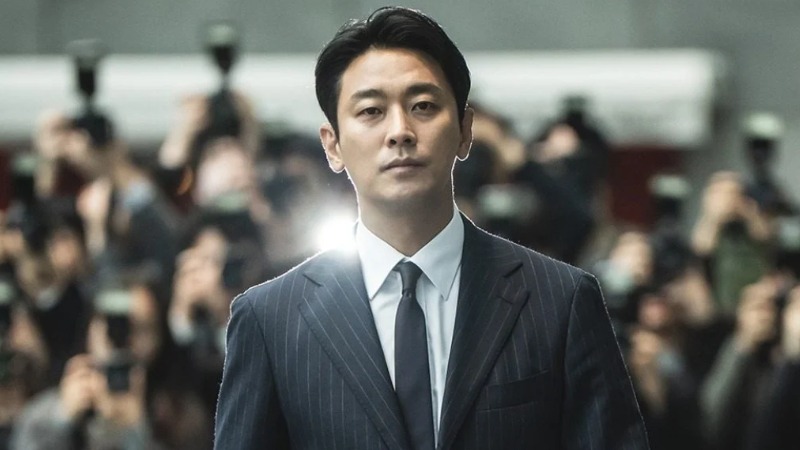
“Climax” is one of 2026’s most talked-about K-dramas, and it earns the attention. Billed as a political survival noir, the drama follows prosecutor Bang Tae-seop (Ju Ji-hoon) as he claws his way from a stagnant career toward the very top of South Korea’s power structure. What starts as one man’s desperate gambit to take down Seoul’s mayor spirals into a ten-episode web of corruption, blackmail, and betrayal that touches everyone around him — including his own wife.
If you’ve ever wanted a K-drama that treats ambition less like a virtue and more like a slow-acting poison, this is it.
The Setup
Tae-seop’s career is going nowhere, so he hatches an audacious plan: take down a corrupt mayor by going after the people who prop him up. That means confronting company head Lee Yang-mi (Cha Joo-young) and, in the process, dragging his own wife, former actress Chu Sang-a (Ha Ji-won), back into a life of scandal she’s spent years trying to escape.
Rounding out the core cast are Oh Jung-se as Kwon Jong-uk, an insider caught between loyalty and self-preservation, and Nana as Hwang Jeong-won, an informant whose conscience puts her directly in the crosshairs of everyone with something to hide.
From there, the show widens its scope into entertainment-industry corruption, slush funds, a presidential campaign, and a mysterious hitman known only as “Shadow” — and nearly every character gets pulled into the undertow.
What Works
The cast is doing career-flexing work. Ju Ji-hoon plays against type here, trading his usual charisma for something colder and more unsettling — a man whose ambition curdles into something closer to self-destruction. Ha Ji-won brings real weight to Sang-a, a woman trying to reclaim a life that keeps getting hijacked by other people’s schemes. Their scenes together have an unusual charge: not romantic in the soft, comforting K-drama sense, but tense and complicated in a way that keeps you off balance.
It doesn’t flinch. “Climax” leans hard into its noir instincts. Nobody here is purely good, alliances shift episode to episode, and the show is willing to let its characters do genuinely ugly things without rushing to redeem them. For a mainstream network drama, it’s unusually committed to bleakness.
A real step forward in representation. The drama places a same-sex relationship at the center of its plot rather than treating it as subtext, which is still rare for a mainstream Korean broadcast drama in this genre. It’s a notable moment for LGBTQ+ visibility in Korean television, especially given the profile of the actresses involved.
What Doesn’t Work
The back half gets tangled. With so many factions, financial schemes, and hidden pasts in play, the plotting occasionally prioritizes shock value over coherence. A few major twists — particularly around blackmail and leaked private material used as a plot device more than once — feel more exploitative than earned.
The treatment of its queer storyline is a mixed bag. While the show deserves credit for centering the relationship at all, some viewers have pointed out that it never actually names what it’s depicting on screen, and that the fates of the queer characters follow an unfortunately familiar pattern where those relationships don’t survive the season.
Sympathy is distributed unevenly. The drama asks viewers to extend understanding to its male lead even after some genuinely difficult moments involving his wife, while giving less room for nuance elsewhere. It’s the kind of choice that will land very differently depending on the viewer.
The Ending (Spoilers Ahead)
::: SPOILER WARNING — skip this section if you haven’t finished the show :::
The finale doesn’t slow down. Tae-seop reluctantly teams back up with Jong-uk for one last move against Yang-mi and her political machine, using financial dirt tied to a presidential candidate and a death that was never properly explained. The evidence isn’t quite strong enough, so Tae-seop pivots to pressuring the hitman “Shadow” directly — a gamble that doesn’t pay off, since Shadow refuses to break.
Jeong-won, the informant played by Nana, doesn’t make it to the end; she’s killed by Yang-mi’s orders in episode 9, shortly after developing real feelings for Sang-a. Her death becomes one of the sparks that pushes Sang-a toward taking her own revenge in the final stretch.
By the last episode, the show’s thesis is clear: power in this world isn’t just corrupting, it’s consuming. There’s no clean exit once you’re in the game, and nearly every major character pays some price for how far they were willing to go. Some viewers found the finale satisfying in its refusal to offer easy resolution; others felt it needed one more episode to actually land its conclusion instead of just tightening the noose and cutting to black.
Should You Watch It?
If you like your K-dramas dark, morally messy, and unwilling to hand out happy endings, “Climax” is worth the ten-episode commitment — largely on the strength of Ju Ji-hoon and Ha Ji-won’s performances. Just go in knowing it’s a bumpy, occasionally frustrating ride, especially in how it handles its more sensitive plotlines.
Have you watched “Climax”? Let me know in the comments what you thought of that ending — I’m still not sure Yang-mi got what she deserved.
