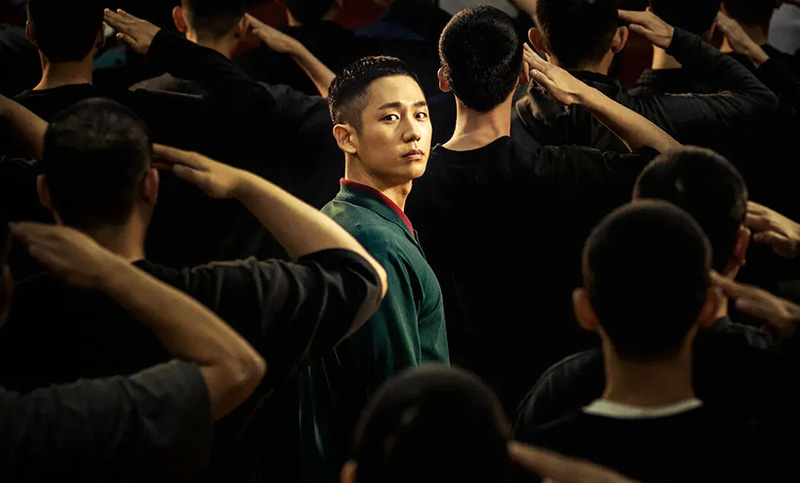
Some dramas entertain you. Others haunt you for days afterward. D.P. firmly belongs in the latter category.
When Netflix dropped this six-episode series in August 2021, it didn’t just become a hit in South Korea—it sparked genuine conversations about mandatory military service, systemic abuse, and the human cost of staying silent. The New York Times recognized it as one of the best shows of 2021, and for good reason. This isn’t entertainment that lets you forget what you’ve watched. It’s the kind that stays with you, uncomfortable and necessary.
What Is D.P. About?
D.P. stands for “Deserter Pursuit”—a real unit in South Korea’s military police tasked with tracking down soldiers who’ve gone AWOL. The story follows Private Ahn Jun-ho (Jung Hae-in), whose sharp observational skills land him in this specialized unit alongside the street-smart Corporal Han Ho-yeol (Koo Kyo-hwan).
What starts as a seemingly straightforward premise—catching deserters—quickly becomes something much more complex. Each case they investigate pulls back another layer of the systematic failures, abuse, and institutional cruelty that drive young men to risk imprisonment rather than continue serving.
The Uncomfortable Reality Behind the Fiction
Here’s what makes D.P. particularly powerful: it’s based on creator Kim Bo-tong’s own experiences during his mandatory military service, as well as actual news stories. This isn’t Hollywood dramatization. The abuse you see on screen—the relentless hazing, the hierarchical violence, the complicit superiors—reflects genuine experiences that countless Korean men have lived through.
The drama doesn’t pull its punches. From the opening scene where Jun-ho is violently slammed against a wall with a protruding nail just inches from his head, you know this series isn’t interested in making anyone comfortable. And it shouldn’t be. These are stories that deserve to be told, no matter how difficult they are to watch.
Jung Hae-in’s Career-Defining Performance
If you only know Jung Hae-in from his romantic roles (Something in the Rain, While You Were Sleeping), prepare for a completely different side of his talent. His portrayal of Jun-ho is restrained, observant, and deeply empathetic. Reviewers praised his performance as sublime, noting it was radically different from the romances he’s known for.
Jun-ho is someone who sees everything—the injustices, the power imbalances, the human cost—and that awareness becomes both his strength and his burden. Hae-in plays this internal conflict beautifully, conveying volumes through subtle facial expressions and controlled body language. You can see him calculating whether to intervene, whether speaking up will make things better or worse, whether he even has the power to change anything at all.
The Dynamic Duo
What prevents D.P. from becoming completely unbearable is the chemistry between Jun-ho and Ho-yeol. Their electric chemistry provides necessary relief in an otherwise dark narrative. Ho-yeol is pragmatic where Jun-ho is idealistic, cynical where Jun-ho still hopes for change. Their banter feels genuine, and their growing friendship becomes the emotional anchor of the series.
Koo Kyo-hwan deserves special mention for creating a character that wasn’t even in the original webtoon. Ho-yeol could have been a one-dimensional comic relief, but instead he’s fully realized—funny, yes, but also damaged, conflicted, and trying to survive a system that chews people up and spits them out.
More Than Just Military Critique
While D.P. focuses on military abuse, its themes resonate far beyond army barracks. This is a drama about institutional failures, about how systems protect themselves at the expense of individuals, and about what happens when good people are forced to choose between their principles and their survival.
Each deserter’s story reveals a different failing of the system: mental health crises ignored, economic desperation dismissed, corruption rewarded, and victims blamed. The drama asks viewers to consider: what would you do in their position? When the system designed to protect you becomes the thing you need protection from, where do you turn?
The Cinematography and Direction
Director Han Jun-hee brings a film-quality aesthetic to the series. The cinematography is gorgeous and unsettling in equal measure—stark lighting that emphasizes the coldness of military life, long takes that let tension build unbearably, and visual metaphors that reinforce the themes without being heavy-handed.
The pacing is tight. With only six episodes, there’s no filler, no wasted scenes. Every moment serves the story, which is probably why so many viewers wished for a longer season. But perhaps that brevity is intentional—like military service itself, you’re thrown into this intense experience and then it ends, leaving you to process what you’ve witnessed.
The Difficult Parts (Content Warnings)
Let’s be clear: D.P. is not an easy watch. The series depicts graphic physical violence, relentless verbal abuse, suicide, and psychological torture. There are scenes that will make you angry, scenes that will make you cry, and scenes that might make you question whether you can continue watching.
But that discomfort is the point. These stories need to be difficult to watch because they represent difficult realities. The drama respects its subject matter by refusing to sanitize or romanticize the violence. It shows you the ugly truth and trusts you to sit with that discomfort.
Who Should Watch This?
Watch D.P. if you want:
- Powerful, socially conscious storytelling that doesn’t compromise
- Outstanding acting, particularly from Jung Hae-in
- A drama that challenges you rather than simply entertaining you
- Insight into Korean military culture and social issues
- Tight, well-paced narrative with no filler
Skip it if you’re sensitive to:
- Graphic violence and physical abuse
- Themes of suicide and self-harm
- Institutional failures and injustice without easy resolutions
- Heavy, emotionally draining content
The Bigger Picture
The show was embraced more warmly in South Korea than even Squid Game, which launched shortly after. That reception speaks volumes about how deeply these issues resonate with Koreans, particularly those who’ve served or have loved ones currently serving.
Since D.P.‘s release, there have been renewed conversations about military reform in South Korea. While a drama alone can’t fix systemic problems, it can change the conversation—making it harder to ignore, harder to dismiss, harder to sweep under the rug. And sometimes, that’s where real change begins.
Final Thoughts
D.P. is one of those rare dramas that accomplishes exactly what it sets out to do. It’s not interested in being likable or comfortable or easy to digest. It’s interested in truth—messy, painful, necessary truth.
Jung Hae-in and Koo Kyo-hwan deliver career-best performances. The writing is sharp and purposeful. The direction is masterful. And most importantly, the drama treats its subject matter with the gravity and respect it deserves.
You won’t enjoy watching D.P. in the traditional sense. You’ll spend much of it feeling angry, sad, or helpless. But you’ll also finish it feeling like you’ve witnessed something important—something that needed to be said, and needed to be heard.
In a landscape saturated with romance and fantasy, D.P. dares to show us the unglamorous reality of institutional violence and the toll it takes on young men just trying to survive. For that alone, it deserves to be watched, discussed, and remembered.
What works: Exceptional acting, unflinching social commentary, tight pacing, meaningful subject matter
What challenges: Graphic violence, emotionally heavy, no easy answers
D.P. Season 1 premiered on Netflix on August 27, 2021. Season 2 followed on July 28, 2023. Both seasons consist of 6 episodes each.
Pro tip: Stay through the credits of the final episode—there’s an important epilogue scene that adds crucial context to the story.
