“Two men. One nation on the edge. And a crime empire built in the shadows of the very government sworn to protect it.”
Overview
When Disney+ announced a Korean drama starring Hyun Bin and Jung Woo-sung — helmed by Woo Min-ho, the acclaimed director behind Inside Men and The Man Standing Next — the anticipation was nothing short of seismic. Made in Korea arrived on Christmas Eve 2025 and delivered exactly what that pedigree promised: a stylish, politically charged, film-noir thriller set against the turbulent backdrop of 1970s South Korea.
This is not a cozy binge-watch. It is a lean, six-episode prestige drama that moves with the deliberate confidence of a feature film — which makes sense, because director Woo Min-ho has stated he filmed it exactly like a movie, refusing to differentiate the production just because it was an OTT series. The result is something closer to a Korean Heat than a conventional K-drama: two towering performances locked in a cold, cerebral cat-and-mouse game, draped in cigarette smoke, moral ambiguity, and the genuine menace of a government willing to do anything to survive.
The Story
The series takes place across the major upheavals of Korea’s modern history in the 1970s, following two men on a collision course: Baek Ki-tae, a shrewd and ambitious operative for the Korean Central Intelligence Agency (KCIA) who secretly controls illicit business networks to amass power and wealth, and Jang Geon-young, a principled, uncompromising public prosecutor determined to expose a corrupt government and the agencies that prop it up.
The premiere episode announces the show’s intentions boldly. It takes viewers back to an almost unrecognizable era — cigarette smoke drifting through commercial aircraft cabins, passengers dressed in their finest — and places Ki-tae aboard a hijacked Japan Airlines flight commandeered by Japanese communist revolutionaries hoping to defect to Cuba, who end up in North Korea instead. From this gripping open, we understand that Ki-tae operates in the spaces between nations, identities, and allegiances.
He is Zainichi — of Korean descent but raised in Japan — and this identity becomes a running thread, as he is fluent in both languages yet unwelcome in either country, the target of intersectional hatred from both sides. It’s a quietly devastating layer that prevents Ki-tae from ever being a simple villain.
Back in Korea, the show properly introduces Jung Woo-sung’s Jang Geon-young: a Busan prosecutor whose tenacity and idealism have stalled his career. An investigation into a married couple murdered by drug-addicted U.S. soldiers leads him toward the KCIA’s illicit activities and directly into Ki-tae’s crosshairs.
The show does not flinch in its portrayal of corruption by both the Korean government and its strongest ally, the U.S. military. Director Woo presents a Korea where there are no true heroes — only desperate survivors caught in the crosshairs. The drug trade, in particular, is rendered with historical specificity: methamphetamine networks entwining Japanese yakuza, Korean intelligence operatives, and American soldiers create a web of complicity that implicates nearly every institution on screen.
Cast & Performances
The casting is impeccable, and the two leads deliver career-defining work.
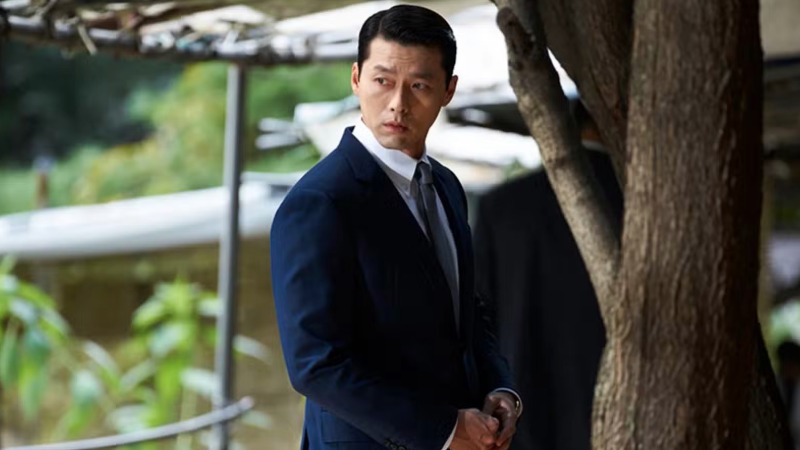
- Hyun Bin (Baek Ki-tae) KCIA operative and underworld kingpin. Cool, detached, and immaculately suited — Hyun Bin commands every frame he occupies.
- Jung Woo-sung (Jang Geon-young) The principled Busan prosecutor and moral anchor of the series. His warmth and eccentricity provide human counterweight to the cold thriller mechanics.
- Woo Do-hwan (Baek Ki-hyun) Ki-tae’s younger military brother. A complex dynamic of love, rivalry, and ambition adds surprising emotional texture.
- Cho Yeo-jeong (Supporting) One of three female leads whose screen time, many viewers feel, was frustratingly limited in Season 1.
- Seo Eun-soo (Supporting) Strong presence whenever on screen, but like the other female leads, underserved by the script’s narrow focus.
- Won Ji-an (Supporting) Impressive in limited appearances; another performer Season 2 should give room to breathe.
Hyun Bin is cool and detached — pressed suits, slicked-back hair — while Jung Woo-sung leans into the endearing eccentricities of his maverick prosecutor. Together they generate the kind of charged, wordless tension that most action dramas spend entire seasons trying to manufacture. Fans have compared the dynamic to Heat — Pacino and De Niro circling each other across a city — and it’s an apt comparison.
For Hyun Bin, this is a deliberate pivot from his romantic lead image. He is returning to a major OTT series for the first time in nearly five years since Crash Landing on You ended in 2020 as tvN’s highest-rated drama of all time. The gamble pays off. His Ki-tae is one of the year’s most magnetic K-drama characters: a man you understand even as you dread him.
✦ ✦ ✦
Direction & Production
Woo Min-ho makes his drama directing debut here and brings with him everything that made his films landmarks of Korean political cinema. The series is shot in a film noir style, with retro musical scoring that heightens the period atmosphere. The production design is lavish: to authentically recreate 1970s Busan, the production spent approximately one month filming in Kobe, Japan, where urban areas with period-appropriate port city architecture provided the visual backdrop.
The series has lavish production values and a deep bench of talent. Every frame feels considered. The 1970s world is not romanticized but rendered with tactile believability — the polyester suits, the smoke-filled offices, the constant low hum of authoritarian menace. It is, without question, some of the most cinematic work to appear on a streaming platform this year.
The writing, by Park Eun-gyo and Park Joon-suk — the team behind The Silent Sea and Mother — is sharp in its dialogue and bold in its historical imagination. Unlike 12.12: The Day, which prioritized historical accuracy, Made in Korea is less concerned with factual fidelity than with “theatre” — cherry-picking and fabricating incidents to spin a tale of clandestine political intrigue. This is a creative choice, not a flaw, though viewers expecting strict docudrama will need to recalibrate.
Strengths & Weaknesses
What Works
- Two career-best lead performances from Hyun Bin and Jung Woo-sung
- Cinematic production quality rarely seen on streaming
- Bold, morally grey storytelling with no easy heroes
- Richly atmospheric 1970s period recreation
- Film noir visual language used with real artistry
- Historically grounded exploration of KCIA corruption and the drug trade
- Woo Min-ho’s assured, movie-calibre direction
- Season 2 already confirmed — the story has room to grow
What Falls Short
- Female leads given criminally little screen time
- Six episodes feels too short for the story’s ambitions
- Some supporting characters serve as symbols rather than people
- The ending is more of a season cliffhanger than a satisfying conclusion
- Pacing may frustrate viewers expecting faster action
- Friendships and sibling dynamics feel underdeveloped
Who Should Watch This?
Made in Korea is built for viewers who appreciate slow-burn political thrillers with rich historical texture. If you loved the moral complexity of The Man Standing Next or Inside Men, or if you enjoy prestige crime dramas in the vein of Narcos or The Americans, this is essential viewing.
Come for the star power of Hyun Bin and Jung Woo-sung, but stay for the grimly compelling portrait of a society where the line between the state and organized crime has been deliberately erased. As one viewer aptly put it, the show is essentially a Korean Death Note with politics, drugs, and morally grey characters everywhere — and no romance necessary.
Be aware: this is a cerebral drama that demands your full attention. Watching it tired after a long workday means you will miss crucial details. The recommendation is to treat each trio of episodes as a single immersive sitting.
Made in Korea is the most confident K-drama debut of 2025 — a production that refuses to think small and largely succeeds on the strength of two outstanding performances and director Woo Min-ho’s uncompromising cinematic vision.
Its shortcomings are real: the female cast members deserve far more, and six episodes leaves the narrative feeling like a prologue rather than a complete story. But what a prologue it is. Season 2 cannot come soon enough.
For fans of political crime drama, this is unmissable. For casual K-drama viewers, approach with patience — and you will be rewarded.
