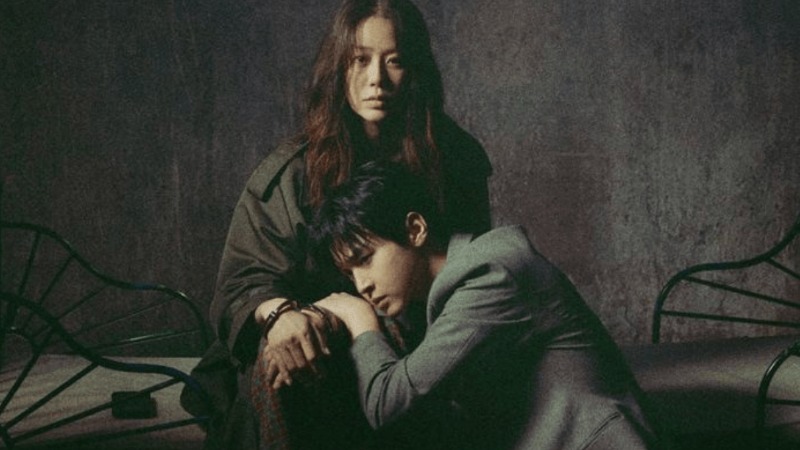
When Korean dramas tackle serial killers, they usually lean heavily on either psychological horror or procedural investigation. Queen Mantis, SBS’s adaptation of the French thriller La Mante, dares to do something more complicated—it asks you to understand a monster without excusing her, to sympathize with a vigilante killer without endorsing her methods, and to watch a mother and son navigate the wreckage of their relationship across a conference table in a prison.
Led by the incomparable Go Hyun-jung in what many are calling the performance of 2025, Queen Mantis is a taut, emotionally complex eight-episode thriller that explores domestic violence, generational trauma, and the blurred line between justice and vengeance. It’s a drama that refuses to offer easy answers or comfortable resolutions, choosing instead to linger in the moral grey zones where most people actually live.
The result is one of the year’s most gripping Korean dramas—imperfect in its pacing and occasionally frustrating in its character choices, but anchored by performances so powerful they transcend the show’s occasional missteps.
The Premise: A Serial Killer Mother, A Detective Son, and a Copycat
Twenty years ago, Jung I-shin brutally murdered five men, earning herself the nickname “The Mantis” for the way she dispatched her victims with cold, methodical precision. All of her targets were violent men—abusers, molesters, and predators who had escaped the justice system’s grasp. To the public, she was a monster. To some, she was a dark avenger.
Her son, Cha Su-yeol (Jang Dong-yoon), has spent his entire life trying to escape her shadow. He changed his name, built a new identity, and became a police officer—perhaps to prove he’s nothing like the woman who gave birth to him, perhaps to find redemption through the very justice system his mother rejected.
Now, a copycat killer has emerged. The murders mirror The Mantis’s signature style with chilling accuracy, and the police are at a dead end. Jung I-shin, imprisoned for two decades, offers her expertise—but only on one condition: her estranged son must be assigned to the case.
What follows is a psychological chess match between mother and son, a cat-and-mouse pursuit of a new killer, and an unflinching examination of how violence—both domestic and vigilante—echoes through generations.
Go Hyun-jung: The Performance of the Year
Go Hyun-jung is without a doubt the standout performance not only in Queen Mantis but for the year. As Jung I-shin, she creates a character who is simultaneously magnetic and repellent, terrifying and heartbreaking, monstrous and painfully human.
Go Hyun-jung plays the Mantis with brilliance—her presence both magnetic and repellent. A woman one is not meant to love, but impossible to forget. She brings incredible depth to a role that could have been one-dimensional. This isn’t a cackling villain or a misunderstood anti-hero. Jung I-shin is something more unsettling—a woman who committed horrific acts for what she believed were righteous reasons, who genuinely loves her son despite the trauma she inflicted on him, and who operates by a moral code that’s internally consistent even if it’s externally monstrous.
Watch Go Hyun-jung’s eyes during the interrogation scenes. There’s calculation there, yes, but also genuine emotion when she looks at her son. The depth she brought to a mother who used brutal methods to dispatch terrible men in their own right, who also longed for her son, was unforgettable.
In one particularly powerful scene, Jung I-shin discusses the men she killed with cold clinical precision, then in the next breath speaks about her son’s childhood with tender longing. The whiplash is intentional—it forces us to hold two contradictory truths at once: this woman is a brutal killer, and this woman is a mother who loves her child. Both are true. Both are horrifying.
If there were any justice in awards season, Go Hyun-jung would sweep every category. This is career-defining work from an actress who has already had an illustrious career.
Jang Dong-yoon: The Burden of Being The Mantis’s Son
Jang Dong-yoon has the more challenging role in some ways. As Cha Su-yeol, he’s not allowed to be heroic or even particularly likable. He refuses to take into account what triggered his mother and this makes him come across as emotionally stunted and petulant. His “holier than thou attitude” can be genuinely irritating.
But here’s the thing: that’s exactly right for the character. Su-yeol is a man who has built his entire identity around not being his mother. He’s rigid, judgmental, and unable to process the complexity of his feelings because acknowledging any understanding of her actions would crack the foundation of who he believes himself to be.
Jang Dong-yoon is very good as the son of Queen Mantis, capturing the internal war between the detective who needs his mother’s expertise and the traumatized child who can’t forgive her. His performance is more understated than Go Hyun-jung’s—necessarily so, as Su-yeol is all repression and contained rage—but it’s equally essential to the show’s emotional core.
The scenes between mother and son crackle with tension. They speak like strangers forced into proximity, every word weighted with decades of unsaid things. Their conversations are less investigative work than tentative steps through the ruins of a shared past.
The Supporting Cast: Solid but Underutilized
The drama assembles a talented supporting cast, though not all are given material worthy of their abilities.
Kim Bo-ra plays Su-yeol’s wife Ha Seol with a quietly supportive presence. Kim Bo-ra played a very understated performance, and while her character arc about standing by her husband as his world unravels is touching, she’s given frustratingly little to do beyond being “the supportive wife.”
Lee El as Detective Kim Na-hee brings intensity to her role, though her performance was like a second fiddle at times. Her character’s backstory feels underdeveloped, and while Lee El does strong work with what she’s given, you sense there’s a more interesting character lurking beneath the surface that never fully emerges.
Cho Seong-ha as Detective Jo Min-jae delivers reliably, though his character was a little bit too wimpy. His role as the detective who originally captured The Mantis and negotiated her unusual imprisonment terms is fascinating, but the show doesn’t quite dig deep enough into that relationship.
The biggest issue is that a lot of this team’s existence made no difference since the main minds working the case were The Mantis and her son. They just existed for manpower. The supporting detectives often feel like obstacles rather than contributors, creating artificial tension by questioning Su-yeol’s presence on the team rather than actually advancing the investigation.
The Domestic Violence Angle: Unflinching and Necessary
What sets Queen Mantis apart from typical serial killer thrillers is its focus on systemic domestic violence as both context and catalyst for the murders. The hunt is not only for a serial killer, but also for a social catastrophe: domestic violence so widespread in South Korea that it has become almost invisible. The police, who should protect, look the other way.
Jung I-shin’s victims weren’t random. They were abusers, child molesters, and violent men who had escaped punishment through corruption, indifference, or the gaps in the justice system. The show doesn’t glorify her vigilantism, but it does force viewers to confront an uncomfortable question: When the system fails victims repeatedly, when justice is denied again and again, where does righteous anger become justifiable violence?
The drama wisely refuses to answer this question. Instead, it shows the human cost of both the original violence (the abuse that Jung I-shin witnessed and experienced) and her response to it (the trauma inflicted on her son, the lives taken in the name of justice). This show looks into the cause of human behavior both nature and nurture. Its premise is ultimately that nurture is the cause and not someone’s bloodline.
The flashbacks to Jung I-shin’s past are handled carefully—graphic enough to convey the horror she witnessed and experienced, but not exploitative. The show trusts its audience to understand the weight of domestic violence without turning it into trauma porn.
The Setting: Ghost Towns and Social Collapse
The drama makes brilliant use of its setting in abandoned mining towns—communities that collapsed economically when the mines closed in the 1980s and 90s. These towns carry an aura of social trauma: unemployment, out-migration, fractured communities.
The decaying workers’ housing, sealed shafts, and half-abandoned settlements provide the perfect backdrop for a story about generational trauma and systemic failure. The physical decay of these towns mirrors the social decay that allowed abuse to flourish unchecked.
There’s something deeply Korean about this choice of setting—these aren’t generic crime scene locations, but real places with real histories of economic abandonment and social breakdown. The show uses this specificity to ground its more extreme elements in recognizable reality.
The Mystery: Red Herrings and Reveals
As a whodunit, Queen Mantis is mostly successful. When it came down to the big reveal, I wasn’t surprised. The red herrings were top notch. The layers, challenging. The show plants clues carefully, uses misdirection effectively, and builds toward a reveal that makes sense within the show’s thematic framework.
The copycat killer’s identity and motivation tie directly into the themes of generational trauma, domestic violence, and the failures of the justice system. It’s not a twist for shock value—it’s a reveal that deepens our understanding of the show’s central questions.
That said, some viewers may find the mystery too straightforward or the clues too obvious. If you’re a seasoned thriller viewer, you might piece together the truth before the reveal. But the strength of Queen Mantis isn’t really in surprising you—it’s in making you sit with uncomfortable truths about justice, violence, and trauma.
The Pacing Problem: Strong Start, Sluggish Middle
Here’s where Queen Mantis stumbles. The show starts off great but for some reason they really slowed down the story by episode 6. The first four episodes are taut, gripping, and perfectly paced. Then the middle episodes lose some momentum, spending too much time on procedural beats that don’t advance the emotional or investigative arcs.
Episode 8 was decent but lacked the impact a proper finale should have. It felt sluggish and devoid of energy that a proper thriller should have. After building so much tension and emotional complexity, the finale feels somewhat anticlimactic—more of a slow exhale than a knockout punch.
Some viewers felt eight episodes was too much. The same could have been achieved in 4-5 episodes, while others appreciated the space to develop characters and themes. The truth is probably that eight episodes is the right length, but episodes 5-7 needed tighter editing and more propulsive plotting.
The show also leaves open the possibility of a second season, which may explain why certain threads feel unresolved. Whether a continuation would enhance or diminish what’s been achieved here remains to be seen.
The Female Characters: Complex and Contradictory
One of the show’s greatest strengths is how it portrays women. The women in this series are no saints. They are opaque, contradictory, dangerous. The other female characters, too, are layered and elusive. By contrast, the men appear as clichéd shadows: policemen, perpetrators, fathers, all in familiar costumes.
This inversion of typical gender dynamics in crime dramas is deliberate and powerful. For once, women aren’t just victims or supportive wives—they’re complex moral actors making difficult choices in impossible circumstances. They’re not always likable, not always right, but always fully human.
Jung I-shin is the most obvious example, but the pattern extends throughout the cast. Female characters are given agency, complexity, and moral ambiguity that male characters in similar roles are rarely afforded in Korean dramas.
How Does It Compare to the French Original?
This version is darker going into more detail regarding the murders. For those familiar with the 2017 French series La Mante, the Korean adaptation takes the core premise but makes it distinctly Korean in its execution.
The focus on domestic violence as a systemic social issue rather than isolated incidents feels specifically Korean. The mining town setting and the economic collapse context are rooted in Korean history. And the mother-son dynamic is played with a different emotional register—more restrained on the surface, more devastatingly painful underneath.
Director Byun Young-joo (making her second drama after Black Out) brings a cinematic quality to the visuals and a steady hand to the tone. Writer Lee Young-jong (who penned the films Flu, The Witness, and 12.12: The Day) makes an impressive television debut, adapting the French material while making it feel authentically Korean.
The Verdict: Flawed but Powerful
Queen Mantis is not a perfect drama. The pacing sags in the middle. Some supporting characters are underutilized. The procedural elements occasionally feel like padding. And the finale doesn’t quite land with the emotional punch it should.
But these flaws pale in comparison to what the show does brilliantly: Although a remake of the French show Mantis, I have found Queen Mantis the best serial killer K-drama to date. The reason comes down to superb acting, very good writing, and restraint with classic K-drama tropes.
Queen Mantis is more than a remake. And more than a thriller. It is a mirror of Korean contradictions: between victimhood and vigilantism, between patriarchal violence and women’s responses to it, between the individual quest for justice and the collective failure of systems meant to provide it.
Go Hyun-jung delivers a performance that will be remembered long after the plot details fade. The show tackles uncomfortable questions about justice, trauma, and the cycle of violence with nuance and maturity. And despite its procedural framework, it’s ultimately a deeply human story about a mother and son trying to understand each other across an unbridgeable divide.
What works: Go Hyun-jung’s career-defining performance, complex moral questions without easy answers, unflinching examination of domestic violence, strong first half, nuanced mother-son dynamic, excellent use of setting
What doesn’t work: Pacing sags in episodes 5-7, underutilized supporting cast, anticlimactic finale, some procedural padding
Watch Queen Mantis if you:
- Want to see one of the year’s best Korean drama performances
- Enjoy psychological thrillers that explore moral complexity
- Appreciate crime dramas that tackle social issues
- Can handle dark subject matter including domestic violence
- Don’t need every question answered neatly
- Love character-driven stories over plot-driven ones
Skip it if you:
- Are sensitive to depictions of domestic violence and abuse
- Need fast-paced thrillers without slower character moments
- Get frustrated by ambiguous morality
- Prefer straightforward heroes and villains
- Can’t handle graphic violence (though it’s not excessive)
Content Warning: This drama deals with domestic violence, child abuse, sexual assault (discussed, not shown graphically), murder, and trauma. While not exploitative, it doesn’t shy away from depicting the reality of violence against women and children. Viewer discretion advised.
Bottom line: Go Hyun-jung’s Queen Mantis is a performance that demands to be seen, anchoring a thriller that’s brave enough to ask difficult questions and wise enough not to pretend there are easy answers.
