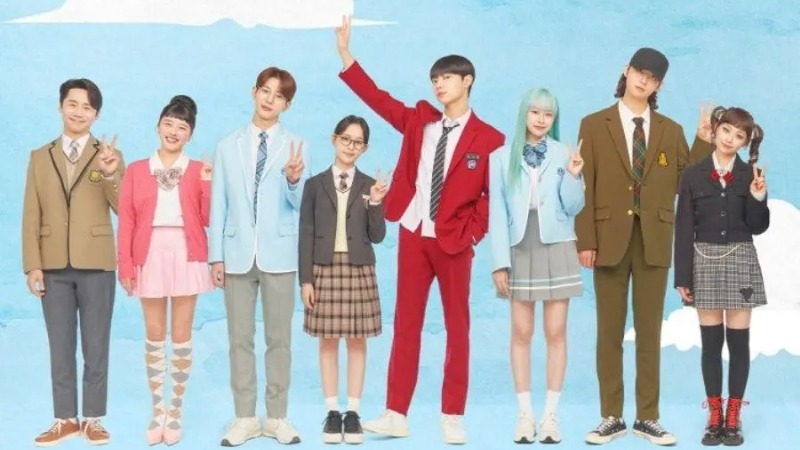
Sometimes the best dramas aren’t the ones with shocking plot twists, makjang family secrets, or high-stakes revenge schemes. Sometimes the best dramas are simply about awkward teenagers finding themselves, making friends, and learning to love who they are—one drawing at a time.
Spirit Fingers, TVING’s adaptation of Han Kyoung-chal’s beloved webtoon, is exactly that kind of drama. After a decade of anticipation (seriously, fans waited 10 years for this adaptation), the series finally premiered in October 2025, and it delivered everything devoted webtoon readers hoped for while charming newcomers who’d never heard of the original.
With an impressive 8.1 rating on IMDb and recognition from Time Magazine as one of the “Top 10 Best Korean Dramas of 2025,” Spirit Fingers proves a profound truth: you don’t need a huge budget or an overly complicated storyline to create something magical. You just need good casting, thoughtful direction, and a genuine understanding of what makes your source material special.
This is comfort viewing at its finest—a warm hug in drama form that will make you laugh, cry, and maybe even pick up a sketchbook.
The Premise: Finding Your Color in a World of Gray
Song Woo-yeon (Park Ji-hu) is the kind of high school student who blends into the background so thoroughly that she’s practically invisible. Painfully shy, lacking confidence, and convinced she has nothing special to offer, Woo-yeon lives a bland, colorless existence defined by studying alone in her room and wondering why she’s so utterly unremarkable.
Her life is a monotone routine: wake up, go to school, come home, study, sleep, repeat. She has one friend—her smart and charming bestie Gu-rin (Park You-na)—but even that relationship is strained by Woo-yeon’s insecurity and inability to express herself.
Then everything changes when she receives a mysterious smartphone message inviting her to join an art club called Spirit Fingers. Despite her complete lack of artistic ability or confidence, something compels her to accept. Maybe it’s curiosity. Maybe it’s desperation for something—anything—different.
What she discovers is a ragtag group of artists, each assigned a color that reflects their personality:
- Red Finger (Nam Gue-rin, played by Cho Jun-young’s older sister in the story): The charismatic, confident president who takes Woo-yeon under her wing
- Blue Finger (Kim Seon-ho, played by Choi Bo-min): The gentle, talented vice president who’s popular, handsome, and skilled at both art and sports
- Green Finger (Nam Gue-rin, played by Cho Jun-young): Red’s younger brother, a charismatic part-time model who’s never experienced real love
- Yellow Finger, Brown Finger, Black Finger, and more—each with their own distinct personalities, struggles, and stories
Woo-yeon becomes “Baby Blue Finger,” and suddenly her boring life explodes into color. Through art, friendship, and the supportive chaos of Spirit Fingers, she begins the terrifying, exhilarating journey of discovering who she actually is—not who she thinks she should be.
What Makes It Special: Faithful Adaptation Meets Perfect Casting
The Webtoon Adaptation Done Right
One of the most common complaints about webtoon adaptations is that they change too much. Writers add unnecessary drama, remove beloved characters, or fundamentally alter what made the original special. Spirit Fingers does the opposite—it stays remarkably faithful to the source material while understanding that live-action requires certain adjustments.
As a webtoon reader, I’m very satisfied with the originality of the story and the casting. Everything fits perfectly. The drama didn’t change the storyline and characters at all like other drama adaptations usually do. They even kept storylines many expected would be cut—like Sera and Tae-seon’s romance and Woo-dol and Bong-gu’s friendship.
The visual aesthetic captures the webtoon’s colorful, artistic vibe. The character designs are so faithful that viewers repeatedly note how much the actors look like their webtoon counterparts. Even the club’s art projects and the specific themes they explore in each episode mirror the original.
For fans who’ve been reading since the webtoon’s debut, this adaptation feels like a love letter—proof that the production team genuinely cared about honoring what made the original beloved rather than just using it as a jumping-off point for something entirely different.
Park Ji-hu: The Heart of the Story
Park Ji-hu (known for All of Us Are Dead) brings incredible depth to what could have been a frustratingly passive character. Woo-yeon’s journey from self-loathing wallflower to confident young woman who knows her worth is the emotional core of the series, and Park Ji-hu makes every awkward, painful, triumphant moment feel completely real.
She captures Woo-yeon’s insecurity without making her pathetic. You understand exactly why she struggles—the overbearing mother, the constant comparisons to others, the internalized belief that she’s fundamentally lacking. But Park also shows us glimpses of the person Woo-yeon could be: funny, creative, caring, brave.
Watching her transform isn’t a sudden makeover montage. It’s gradual, messy, with setbacks and breakthroughs that feel earned. Some viewers found Woo-yeon frustrating at times—her insecurity can be exhausting, especially when she has people like Nam Gi-jeong believing in her. But that’s also realistic. Confidence isn’t built overnight, and self-love is a journey, not a destination.
Cho Jun-young: The Breakout Star
While Park Ji-hu anchors the emotional journey, Cho Jun-young (making his acting debut) steals scenes as Nam Gi-jeong, the confident, charismatic Green Finger who becomes Woo-yeon’s love interest.
Gi-jeong is the kind of character who could easily become a generic male lead—handsome, popular, good at everything. But Cho brings energy, comedic timing, and genuine warmth that makes him irresistible. His sense of comedic timing is extraordinary, and his chemistry with Park Ji-hu is fantastic.
Multiple viewers noted that despite being a rookie actor, Cho Jun-young delivers a performance worthy of a seasoned professional. He makes Gi-jeong feel like a real teenager—confident but not arrogant, supportive but not condescending, romantic but not cheesy. The way he looks at Woo-yeon, encouraging her without pressure, believing in her when she doesn’t believe in herself—it’s swoon-worthy without being overdone.
One reviewer captured the general sentiment perfectly: “I personally love the male lead, he is a great actor for such a rookie. I hope he gets cast in so many dramas and movies in the future.”
The Supporting Cast: Every Color Shines
What separates Spirit Fingers from typical teen romances is how much care is given to the entire ensemble. Each Spirit Fingers member gets their moment to shine, their own arc, their own struggles and growth.
Choi Bo-min as Blue Finger (Kim Seon-ho) brings gentle charm to the role of the talented, popular vice president. His character’s kindness and artistic talent aren’t just there to contrast with Gi-jeong—he has his own story and his own journey.
Park You-na as Gu-rin, Woo-yeon’s best friend, could have been relegated to “supportive friend” territory, but the drama gives her genuine development, particularly in her romantic subplot with Byeon Soon-ho that viewers absolutely adored.
The other Spirit Fingers members—Yellow, Brown, Black, Khaki—each bring distinct personalities that make the club feel like a real, lived-in community rather than just background characters. Lee Jin-hyuk as Brown Finger (Dong-geon) particularly stands out, as does the actress playing Black Finger (Ko Taeng-ja), who viewers praised for recognizing and dealing with a bully straight away.
One viewer summed it up beautifully: “The cast is amazing too—everyone gets their own moment and the director/writer gives such fair screen time. No one feels left out and I LOVE that.”
The Romance: Two Couples, Double the Heart Flutters
Woo-yeon and Gi-jeong: Confidence Meets Insecurity
The primary romance between Woo-yeon and Gi-jeong works because it’s fundamentally about growth, not just attraction. Gi-jeong doesn’t “save” Woo-yeon or “fix” her insecurity—he creates a safe space for her to discover her own worth.
The height difference between the actors adds to their visual chemistry (K-drama fans love a good height gap), but it’s the emotional dynamic that makes them compelling. Gi-jeong has never experienced real love before; he’s coasted on looks and charm. Woo-yeon makes him dream of more, want more, feel more deeply than he knew was possible.
Meanwhile, Woo-yeon learns that she’s worthy of love exactly as she is—not once she becomes more confident, not once she’s prettier or more talented, but right now, awkwardness and all.
Their moments together are genuinely cute without being cringey—a difficult balance to strike. One viewer who typically hates “cheesy and cringe shows” noted: “This is none of that… U-yeon and Gi-jeong are so cute.”
Gu-rin and Seon-ho: The Soft Couple
The secondary romance between Gu-rin (Green Finger, not the character name but the actress Park You-na’s character) and Kim Seon-ho (Blue Finger) provides a different flavor—soft, gentle, adorable without the dramatic tension of the main couple.
Multiple viewers obsessed over this pairing: “Don’t even get me started on Nam Gue-rin (Green Finger) and Kim Seon-ho (Blue Finger)… I am OBSESSED. Their relationship is soooo soft and adorable. They’re literally the definition of a cute couple.”
The drama balances both couples beautifully, giving each relationship enough screen time and development without one overshadowing the other. The chemistry between the lovers in the two couples was fantastic, creating double the swoon-worthy moments.
The Spirit Fingers Club: More Than Just a Plot Device
What makes Spirit Fingers special is how the art club itself becomes a character—a safe haven where misfits, dreamers, and wounded souls can express themselves without judgment.
Each episode features the club tackling different artistic themes and projects, from street art to collaborative murals to personal expression pieces. These aren’t just pretty visuals—they’re metaphors for the characters’ internal journeys.
The whole Spirit Fingers plot was beyond fun—so much so that even though I don’t like drawing, I wanted to join them. It felt nice to look forward to each meeting and see which theme they chose next.
The club provides what these teenagers can’t find anywhere else: unconditional acceptance. No matter your skill level, your personality, your background—if you’re in Spirit Fingers, you belong. That simple message, delivered through colorful art projects and supportive friendships, resonates deeply.
For viewers who are artists or creatives, the drama captures something essential about why we create—not to be good or successful, but to express what words can’t capture, to process feelings too big for our bodies, to connect with others through shared vulnerability.
One viewer who’s now an art student credited the original webtoon: “This webtoon is the reason why I keep on drawing… I love how perfect the cast is!!”
The Themes: Self-Love, Communication, and Finding Your Voice
Beneath the cute romance and artistic projects, Spirit Fingers tackles substantial themes:
Self-Worth and Confidence
Woo-yeon’s journey from self-loathing to self-acceptance is the emotional backbone. The drama doesn’t pretend this transformation is easy or linear. She takes steps forward, then stumbles back. She has breakthroughs, then moments of crippling doubt.
But gradually, through the support of Spirit Fingers and her own hard work, she learns to love herself—not in a narcissistic way, but in the fundamental “I deserve kindness and respect” way that so many people struggle with.
The message is clear: It’s okay to be different. It’s okay to be you.
The Importance of Communication
One recurring frustration for viewers was characters not communicating—keeping secrets, making assumptions, suffering in silence when a simple conversation could solve everything.
Some saw this as a flaw: “Sometimes I just wanted to scream, ‘Communicate, please!!'” But it’s also realistic. Teenagers (and adults) struggle with vulnerability. We assume people won’t understand, or we’re protecting them by staying silent, or we’re too afraid of rejection to risk honesty.
The drama uses this pattern deliberately, showing how silence breeds misunderstanding and pain, while honest communication—even when it’s scary—leads to connection and growth.
Family Pressure and Expectations
Spirit Fingers doesn’t shy away from the darker aspects of Korean family culture: the crushing parental expectations, the constant comparisons, the pressure to succeed at all costs.
Woo-yeon’s mother is overbearing and critical, unknowingly crushing her daughter’s spirit with every “Why can’t you be more like…?” Gi-jeong and his sister deal with their own family dynamics. Other characters face divorced parents, financial struggles, and the weight of being the “smart one” or the “disappointing one.”
One viewer wished K-dramas would “change it up a little without such a strong focus on bullying and strict parental demands,” and it’s a fair critique—these are well-worn tropes in Korean youth dramas. But the drama does handle them with nuance, and there’s satisfaction when characters finally speak up for themselves.
What Works: Wholesomeness, Humor, and Heart
It’s Genuinely Funny
Spirit Fingers isn’t a comedy, but it’s consistently hilarious. The humor comes from character dynamics, awkward situations, and perfectly timed reactions rather than forced gags.
“This show is so funny istg I laughed like a maniac,” one viewer reported. The comedic timing—particularly from Cho Jun-young—elevates scenes that could be melodramatic into something lighter and more charming.
The Pacing Feels Natural
At 12 episodes of roughly 55 minutes each, the drama doesn’t overstay its welcome or rush important moments. The storyline was well-paced, and the character development was strong. Each episode moves the story forward while giving characters room to breathe and relationships space to develop.
Most viewers felt the progression was satisfying, though some wished for more episodes or even a second season to continue the story.
The Visuals Are Dreamy Perfect
The cinematography captures the artistic, colorful aesthetic of the webtoon without feeling artificial. The art projects look genuine, the school and club settings feel lived-in, and the overall visual palette reflects the emotional tone—gray and muted at the beginning, gradually filling with color as Woo-yeon finds herself.
It Feels Personal and Relatable
Despite being set in a specific cultural context, the themes of Spirit Fingers are universal. Anyone who’s ever felt inadequate, struggled with confidence, or wondered if they’d ever find “their people” will see themselves in this story.
“I really loved how realistically the growth of the main characters was shown,” one reviewer noted. The drama doesn’t take shortcuts or offer easy answers—it shows the messy, gradual process of becoming who you’re meant to be.
What Doesn’t Work: Rushed Ending and Frustrating Characters
The Last Episode Feels Rushed
The most common complaint about Spirit Fingers is that the finale tries to cram too much resolution into too little time.
“I just felt the last episode was way too rushed. Every fight and confrontation was obviously meant to happen but they just bombarded everything in the last episode. And everything just got magically fixed after that.”
After spending 11 episodes building conflicts and tensions, the drama resolves them too quickly in episode 12. Character confrontations that deserved full exploration get glossed over. Emotional beats that should linger get abbreviated.
The result is an ending that’s happy and satisfying on paper but feels somewhat hollow because we didn’t get to fully experience the journey to that resolution. That’s not how things work in real life, and it makes the finale feel less earned than it should.
Some Characters Can Be Frustrating
While the character development is generally strong, certain personality traits grate on viewers’ nerves:
Woo-yeon’s insecurity, while realistic, can feel exhausting. “I lowkey dislike her sometimes because of her insecurity. Like girl, you have NAM KI-JEONG. This man is CONFIDENCE in human form.”
The drama has heart and meaning, but the characters can be frustrating—and there’s a high chance you’ll end up disliking at least two people by the end. Some characters keep secrets that hurt people they love, and the justifications don’t always land.
The “Beautiful Lessons, Messy People” Problem
One reviewer perfectly captured the drama’s central tension: “This drama is packed with some really solid messages… But if we push the messages aside and look only at the story? I can’t say I loved it. Yes, everyone has their own scars, but does that give them the right to make someone else suffer? Especially someone they’ve known since forever, someone who keeps trying their best to make them feel safe?”
The drama sometimes prioritizes thematic messaging over character logic, which can create moments where you’re nodding along with the lesson but frustrated by the character choices that got us there.
The Cultural Impact: A 10-Year Wait Worth Having
The fact that Spirit Fingers took a decade to get from webtoon announcement to screen speaks to both the challenges of adaptation and the devotion of its fanbase.
“I read the webtoon when I was in high school, and now it’s been 10 YEARS since it was released—like?? I feel ancient but also emotionally fulfilled??”
That emotional fulfillment is shared by countless fans who grew up with the webtoon and finally got to see their beloved characters brought to life. The special screenings held weeks before the official premiere, the talk concert with the original creator and director, the production presentation—all signal how much this adaptation mattered.
Time Magazine’s recognition as one of 2025’s best Korean dramas validated what fans already knew: this simple story about teenagers and art and self-discovery resonated far beyond its modest premise.
Who Should Watch Spirit Fingers?
Watch Spirit Fingers if you:
- Love heartwarming coming-of-age stories
- Want a drama that’s comforting and wholesome
- Enjoy slice-of-life content focused on friendship and personal growth
- Are looking for cute, non-cringey romance
- Appreciate faithful webtoon adaptations
- Need something uplifting after darker dramas
- Are interested in art or creative communities
- Value character development over plot twists
Skip it if you:
- Need fast-paced plots with constant drama
- Get frustrated by characters who don’t communicate
- Can’t handle insecure or flawed protagonists
- Prefer action, thriller, or mystery genres
- Want something darker or more mature
- Need every loose end perfectly tied up
The Verdict: Comfort Viewing at Its Finest
Spirit Fingers isn’t trying to reinvent the wheel. It’s not going to blow your mind with shocking twists or keep you on the edge of your seat with suspense. What it does do—beautifully, warmly, sincerely—is tell a simple story about finding yourself and the people who help you become who you’re meant to be.
This is comfort food in drama form. It’s a warm blanket on a cold day. It’s that friend who says “you’re doing great” when you feel like you’re failing at everything.
Spirit Fingers proves that a perfect drama can come from a simple storyline and a modest budget. It just requires good casting and the right direction. The formula works because everyone involved clearly cared—the actors commit fully, the directors honor the source material, and the writers trust that small, human moments can be just as impactful as grand dramatic gestures.
Is it perfect? No. The ending is rushed, some characters frustrate more than they should, and if you’re not in the mood for gentle slice-of-life, it might feel too slow.
But for those who want a drama that makes them feel good, that reminds them why friendship matters and why being yourself—awkward, messy, imperfect you—is not just okay but beautiful? Spirit Fingers is a masterpiece.
It’s one of those rare coming-of-age dramas that feels soft, funny, and deeply personal all at once. It’s not just about art—it’s about growing up, finding your voice, and learning to love yourself in a world that keeps trying to define you.
And sometimes, that’s exactly the story we need.
What works: Perfect casting across the board, faithful webtoon adaptation, heartwarming friendships, non-cringey romance, strong character development, wholesome healing vibes, humor that actually lands, relatable themes
What doesn’t work: Rushed final episode, some frustrating character choices, communication issues could try patience, familiar bullying/family pressure tropes
Pro tip: Don’t skip the clips after the ending credit previews—there are bonus scenes!
My comfort drama of 2025. If you’re tired of dark murder-themed dramas, try the far more enjoyable and innocent Spirit Fingers—especially if you like to draw or paint. This is a drama for artists, in more ways than one. 🎨💛
